outputGenerated with EulogyAI using AI
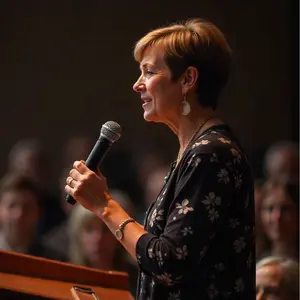
Good afternoon, everyone.
Thank you for coming in bright colours, with music in your pockets and laughter close by.
Decky would be nodding at the sight of it.
He told us not to turn today into a grey day, and sure enough, here we are, bringing a bit of colour to match the man.
I’m speaking as a neighbour who became family by choice.
Tallaght put us side by side, and Declan Byrne—our Decky—made sure we never drifted far.
He was my mentor and my mischief‑maker‑in‑chief, the fella who could turn a Tuesday into a story worth telling.
Born in Dublin on the 5th of May, 1960, Decky learned early what the hands can do when the heart is set on it.
Straight out of school he took the carpentry apprenticeship, and he never looked back.
He opened his own workshop in Tallaght—small at first, then busy, then buzzing—where Irish oak met patience and pride.
He made furniture that didn’t shout; it settled into a room like it had been there forever.
He mended old boats on Lough Derg with a reverence that bordered on prayer, listening to the wood the way some listen to hymns.
And he mentored dozens of apprentices, the kind of teaching that leaves fingerprints on a life without a trace of a lecture.
You knew you were in good company when Decky greeted you with that firm handshake.
Sawdust on the sleeve, pencil behind the ear, twinkle in the eye like he’d already spotted a solution you hadn’t even named yet.
He had a gift for making problems feel smaller—measuring once, looking twice, and saying, “We’ll sort it.”
And he always did.
Brigid, forty years of marriage is a piece of craftsmanship in itself.
He never tired of saying your name.
If we’re measuring a life in the things that last, the love between you two is solid oak.
Liam, Nuala, and Eimear, he spoke about you the way a proud man shows a finished table—running a hand over every grain, telling the story of where it came from, the knots that gave it character, the polish that brought out the shine.
And to the grandchildren—he was the kind of grandad who’d build a fort and call it architecture.
Banjo, your most loyal understudy, will be looking for him by the shed door at four o’clock, certain he’ll be out any minute.
Decky taught so many of us—apprentices, neighbours, complete strangers who’d knocked on the wrong door but left with a hinge mended and a plan for the week.
He had time.
It’s a rare thing, and he spent it freely.
He’d stand in his shed, showing a young lad how to set a plane just so, and you could see the penny drop—patience made visible.
He believed in craftsmanship over shortcuts.
“If it’s worth doing, it’s worth doing properly,” he’d say, and then he’d show you what properly looked like.
His workbench had its own weather—sunlight through the dusty window, the steady tap of a mallet, the scent of fresh‑cut oak that you can almost smell now if you close your eyes.
He left every place a bit better than he found it: the kitchen table with a new leg, the neighbour’s gate that stopped squealing, a community theatre stage that looked like magic and stood like a fortress.
Speaking of stages—there’s one night I’ll never forget.
The summer fête was due to start the next day, and the stage hadn’t arrived.
Panic was floating around the cul‑de‑sac.
Decky clapped his hands once and said, “Right so.”
By midnight he’d rallied half the street.
Kettles boiled on an endless loop, tins of biscuits marched from house to house, and there was Decky in the middle of it, measuring by eye, telling stories, and making a dozen of us believe we could build anything.
We laughed so much that night I forgot it was work.
By sunrise the stage was up, solid as a promise.
He took two steps onto it, bounced once like a child testing a diving board, and said, “That’ll hold a good tune.”
It did.
So did he.
He wasn’t just about wood and nails.
He was dawn fishing trips that smelled of river and tea.
He was the bodhrán at the Tuesday trad session, keeping time in the corner, lifting the whole room with a rhythm that felt like a heartbeat.
He was GAA on Sundays—opinions at the ready, fair play required, and a running commentary that could have filled a radio slot.
He could fix nearly anything with a bit of twine and a smile, though he’d insist on coming back the next day with the proper part, “for the sake of the thing.”
Community theatre owes him more than a thank you.
He was the quiet engine of those sets—arches that made you say wow and flats so sturdy you could lean your whole weight on them between scenes.
He’d stand in the wings during opening night, wiping a smear of paint off a bolt that no one in the audience would ever see, grinning like a man who’d snuck joy into a room without being caught.
He had stories, of course he did.
Not the kind that elbow for space, but the sort that sit with you on a doorstep and take just long enough to brew the tea.
He’d give you the beginning and the middle, and then make you finish the end yourself.
That was his way—show you the grain, let you see what it wants to become.
To those he mentored, I know you’ll miss his way of standing just over your shoulder, quiet until you needed him.
You carry him forward every time you mark a true line, every time you choose the better joint over the faster one, every time you share what you know with someone coming up behind you.
To Brigid, to Liam, to Nuala, to Eimear, and to the grandchildren—your grief has the shape of a big, warm man with sawdust on his jumper and a joke just landing.
There’s no hurrying the missing.
But there’s comfort in the way he built, because everything he made—furniture, friendships, family—was built to last.
You’ll hear him in the small, ordinary moments: when you tighten a loose screw without muttering; when a door closes with a proper click; when a problem shrinks at the sound of “We’ll sort it.”
He’s there.
He came into the world on May the 5th, and he left us on March the 28th this year, sixty‑five years lived with purpose.
Those numbers matter, but they don’t tell you the measure of the man.
It’s in the fingerprints on a bannister he sanded smooth.
It’s in the laughter that followed him into every room.
It’s in the apprentices who now set their own benches at the right height because “your back will thank you later.”
It’s in the thousands of little fixes—hinges, hearts, and hard days—that he made easier.
He asked for today to be bright, and for music rather than hush.
We’re doing our best at that.
Later, the family will plant an oak in his honour.
It’s exactly right.
He loved Irish oak; he worked with it, listened to it, and turned it into things that served and stayed.
An oak takes its time.
It stands steady.
It shelters.
It will carry his story the way he carried ours.
There’s a memory book being put together—photos and stories welcome.
If you have a tale of Decky that lives in your head or a picture where he’s hidden in plain sight behind a plank and a grin, share it.
Don’t tidy it up.
Let it be as real as he was—mud on the boots, tea ring on the plan, banter in the margins.
What will we miss most?
The handshake that grounded you.
The whiff of fresh sawdust that somehow made you feel at home.
The way he could reduce a knotted problem to a clear plan—“First we’ll do this, then that, then we’ll have our tea.”
We’ll miss the Tuesday rhythm, the Sunday commentary, the early‑morning text that just read, “Dawn looks fair.”
We’ll miss Banjo trotting at his heels, king of the cul‑de‑sac, en route to sort a neighbour’s shelf.
But look around.
He’s everywhere in this room.
In the shelves he hung for half of us.
In the chairs he made that hold us now.
In the bright jumpers and the tapped toes and the way people are drifting toward each other to help without being asked.
He’d like that.
If he could leave us with directions—and God knows he loved leaving a good sketch on the back of an envelope—I think they’d be simple:
Do it properly.
Mind your neighbours.
Teach what you know.
Leave things better than you found them.
And keep a biscuit tin full, because work and craic both go easier with a cuppa.
Decky, thank you for the steady magic of your days.
For the patience that turned clumsy hands into confident ones.
For the mischief that kept us all young.
For the oak and the boats and the bodhrán and the stage that held our songs.
You made a life that will not wear out.
We’ll carry you with us—
in the tools you taught us to trust,
in the music you set us to keeping,
and in the kindness you practiced as easily as breathing.
Rest easy, a chara.
We’ll sort the rest from here.
And we’ll do it the way you showed us—
true, square, and with a twinkle.